Showing posts with label sustainability. Show all posts

Thursday, February 09, 2023

How to have a sustainable Valentine’s Day

How to have a sustainable Valentine's Day
By Naomi Yaeger
Commissioned Earthkeeper in the United Methodist Church
I took a photo of Valentine's Day at my house about a year ago. The glass jar contains dried mint for our tea. My husband grew the mint in his garden. 

I took these photos the last couple of years on Valentine's Day. Instead of purchasing something new that would go to waste, I served tea. My husband had grown mint in our garden the previous summer. It is dried and in a glass jar on the right.

Valentine's Day is approaching. Is this a day you celebrate? If you are a child, maybe you have a party at school. My husband has fond memories of Valentine's Day parties during elementary school. For me, it has always been a fun day. My mother made it fun. Examples of how she made it fun are heart-shaped cookies frosted with pink or red icing, a heart-shaped cake, or some memorable food. Sometimes she gave me a unique pair of panties or tights even after I married.

The American Retailers Federation probably loves Valentine's Day because last year, Americans spent $23.9 Billion on gifts for partners, friends, and pets. Pets! Oh my! I think that's a little ridiculous. But it goes along with my point of making it a fun day even if you don't have a sweetheart.

The top five gifts consumers give are candy, greeting cards, flowers, an evening out, and jewelry.
Make your Valentine's Day fun. But, make sure you are showing love to the earth also.


Can you make something like a homemade card, cookies, or treat?
If you do purchase candy, look for candy that is wrapped most sustainably. Can you recycle or compost the wrapper? How much plastic is used to wrap the candy? With chocolate, look for Fair Trade chocolate. The industry has a history of using slave labor. If purchasing flowers, look for fair trade flowers. Who grows the flowers? Are they paid a fair wage? Are they exposed to toxic sprays while working?

I have included some Fair Trade logos in this column for you to check before purchasing.
Two are better than one because they have a good return for their labor. ~ Ecclesiastes 4:9


Thursday, October 21, 2021

Let nothing be wasted

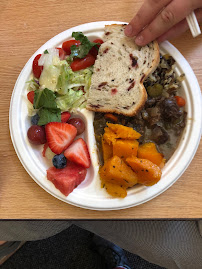
A traditonal feast on a compostable plate

A plate of food during a feast at the
 Fond du Lac Tribal and Community College,
 this plate has venison rather than walleye.


By Naomi Yaeger,
Commissioned EarthKeeper, United Methodist Church

The Environmental Institute at Fond du Lac Tribal and Community College (Cloquet, Minn.) studies promotes sustainable agriculture, and other topics through the use of a medicinal garden, beehives, and a greenhouse. I am fortunate to work for the Institute as a part-time student.


Recently we celebrated Sustainability Awareness Week. We kicked off with a feast of Indigenous foods: fried walleye, maple roasted squash, manoomin (wild rice), cranberry bread, and Baby Cakes (cupcakes baked with wild rice flour and maple syrup made by an Ojibwe mother/daughter team).


Before feasts, tobacco and prayers are offered. At one of our feasts, we all stood waiting patiently. I was anxious, however, as no one knew who was going to offer the prayer. One young woman was asked to give the prayer. She said she couldn’t because she didn’t know Ojibwe well enough. Someone replied, “If you didn’t have a voice do you think the Great Spirit wouldn’t know when you were praying.”
Cupcakes made with wild rice flour  and maple syrup by Baby Cakes 
Wild Rice Bakery/Savage Girls Salads

I particularly liked it when she asked, “If you didn’t have a voice would the Great Spirit hear you.” The answer is, “Of course, the Great Spirit would hear you!”
 

My role at the feast was to facilitate composting. I collaborated with other team members to make sure we had compostable dinnerware and contacted Western Lake Superior Sanitary District (WLSSD) to reserve a party kit (which included special bins, compostable liners, and signage) and transport it. At the college, I cheerfully informed people that their dinnerware and all food waste were compostable and showed them exactly where they could dispose of their waste. I’ve found that many people want to do the right thing but are confused. This is true at church. People are often unsure of what they need to dispose of is recyclable or compostable.

                           A coworker and fellow student, Haley, poses beside he composting and recycling station. The large green bags in nearest to her are compostable plasticand are used to collect the dinnerware and leftovers.


I suggest you think of God when you recycle or compost. Unlike, humans God doesn’t waste anything. I think composting is actually a miracle. Make it into an act of conscious gratefulness to the Lord. (God will hear you if even you don’t vocalize it.) Consider when Jesus fed the multitude with 5 loaves and 2 fish in John 6:12, after the meal he said, “Gather the pieces that are left over. Let nothing be wasted.”


(Naomi Yaeger is a commissioned United Methodist Earthkeeper. Contact her at sun_dog_press@yahoo.com, phone or text (218) 591-5277. For more information visit https://umcmission.org/EarthKeepers/)


The author, Naomi, acknowledges that many hurtful events aimed at Native Americans that have and continue to take place in the name of Christianity. Her writings are an attempt to see commonalities with what she believes within the teachings of John Wesley and what she has learned from her Native American coworkers, classmates and friends.


“Gather the pieces that are left over. Let nothing be wasted.”

John 6:12


This venison stew was actually served at another feast than the one the other writes about in this post.
It included cranberry and maple syrup.


Wednesday, November 18, 2020

My friend gave me toilet paper as a gift!

For God So Loved the World


By Naomi Yaeger, 

UMC Earthkeeper


Christmas is coming. Have you thought about sustainable gifts you could give?

My friend gave me toilet paper for my birthday!

It was not because of COVID and hoarding situations, but because the company doesn’t use plastic for packaging and because it’s made from bamboo, which grows faster than trees. It arrived “pre-gift-wrapped” in colorful paper. The company gives 50% of its profits to building bathrooms.


I feel a little naughty writing this in, but the company's name is “Who Gives a Crap” -  whogivesacrap.org. The company gives money to WASH, which stands for Water Sanitation and Hygiene.


As a United Methodist, I’m proud that WASH is a recipient of the Global Ministries of the United Methodist Church Advance # 3020600.


Think about what YOU could do this Christmas to bless a friend or family member with a sustainable, useful gift. 


I’m giving bars of soap I made at a local business Mix Cosmetiques mixcosmetiques.com . 

Some 10 % of everything Mix Cosmetiques sells goes to teaching women in Uganda how to make cosmetics and start their own businesses.


When Christians think of Christmas, they often think of John:3:16 -- how God reached out to them to enter into a personal relationship. I want you to remember how much God loves YOU. In addition, this Christmas, look again at what God loves enough to send God’s own Son—the world. God’s own creation! All of creation, not just humans. If God so loved the world, then we also need to. Choose at least one aspect of creation and love it through your actions and advocacy.


Sources: umcreationjustice.org and whogivesacrap.org  and umcmission.org

Saturday, November 14, 2009

Superior Grown Food Summit discusses our role in what we eat

Caption: Rick Dale spoke about his experience as a blueberry farmer near Bayfield Wisconsin. He owns Highland Valley Farm, Bayfield, WI. Website: http://www.bayfieldblues.com/

Today I attended the Superior Grown Food Summit. The topic was food security and how we might do that with locally grown foods. I truly believe in consuming locally grown foods. I try to do that and also try to eat organic foods. Last summer we had a community garden. It was interesting for me to listen to the people who wanted to get into farming, as what I would say is a small-time farmer, not a huge mega farm, because many of my relatives left the farm. Farming is very hard work.

I stayed until 2 p.m. I took lots of notes, but I am getting tired now. I hope to post something more about this event.


You may also visit the site www.superiorgrown.com


Caption: The keynote speaker was Darrin Nordahl. He talked about growing food in public spaces like boulevards and landscaping around parking lots. This photo shows graphs of the obesity epidemic in the United States since 1990. Some states have a good size of their population at over 40 pounds overweight. He is the author of
Public Produce: Building a New Urban Agriculture. He currently works at the Design Center Davenport, IA

Here is a list of the guest speakers along with weblinks.

The Lure of the Local: What's Happening in the Local Foods Movement and Why?" (30 min.)
Maggie Adamek, Executive Vice President, Fourth Sector Consulting

A Locally Adapted Food System Assessment (30 min.)
David Abazs, David Syring, and Stacey Stark, University of Minnesota, Duluth

11:00am-12:15pm: Panel II: Building Blocks for Locally Adapted Food Systems

Family Farms and Locally Adapted Food Systems (30 min.)
Rick Dale, Highland Valley Farm, Bayfield, WI

Integrated Farming Systems for Adding Value: The Case of Free Range Poultry (30 min.)
Reginaldo (Regi) Haslett-Marroquin, Rural Enterprise Institute, SE MN

12:30-2:00pm: Keynote Speaker during Lunch
Public Produce: Building a New Urban Agriculture
Darrin Nordahl, Design Center, Davenport, IA
-------

Thursday, May 22, 2008

Church members work together to prevent water pollution from the runoff of parking lot

With beautiful Lake Superior in the background members of the First United Methodist Church in Duluth, Minn. swept of the winter's collection of sand, gravel and salt.

Even the bags used to collect the debris were recycled.


This April members of the First United Methodist Church aka "The Coppertop," wore work clothes and brought brooms to the Sunday service. It was time to sweep the sand, silt and salt off the church's parking lot before the spring rains sweep away the grit thus adding it right into Lake Superior which, by the way, the city uses for drinking water.

The church's sustainability committee thought up the idea. The sustainability committee met and worked on a weekday evening to get a head start. The following Sunday members grabbed their brooms and joined in. A dinner was also provided. It was stressed that anyone could join at the dinner, you didn't have to participate in the sweeping.

The activity succeeded in stopping some pollution and demonstrated to the congregation that we are able to take steps on our own to help the environment. It was also an educational activity for anyone attending church or reading the church bulletin or newsletter.


Visit this site to learn more: Lake Superior Streams.